What’s not to love about a great picnic? For this month’s First Monday Menu, I thought we’d take a look at some picnic menus and learn some 1940s picnic etiquette. Tomorrow, I’ll offer up a few more picnic menus and corresponding recipes, and I’ll show you the ones we made here this past weekend.
When I first started researching picnic menus, I found that many of the things I was reading included backyard barbecues, and most assumed there would be a fire to cook over no matter where you were eating. In fact, almost everything I read suggested taking paper plates so everything could be burned and picnickers wouldn’t have to worry about hauling out trash. Again, there seemed to be the idea that every meal–even picnics–needed a hot dish, and a fire was the way to accomplish that. In fact, “Building a Picnic Fire” was in the middle of Emily Post’s picnic etiquette section.
Picnic etiquette sounds like a great place to start. In the 1942 edition of Etiquette, Emily Post wrote about picnics in two different chapters. The first mention was in the chapter called “On the Street–In Public”. She described a scenario where the reader might want to stop their car where there was a pretty view and picnic on the roadside. Her advice was to find a place wide enough to pull off the road so the car was out of the way of traffic. Post also was adamant about cleaning up after yourself and not disturbing property–especially if it was private property. She also made sure to remind readers to put out their fire and cover the ashes with dirt.
The second place she wrote about picnics was in the chapter titled “Simple Party Giving”. In addition to telling the reader how to build a picnic fire, she offered advice on packing the perfect picnic. I’ve summarized some of her best advice:
Offer more than one variety of sandwich and fix sandwiches ahead of time to prevent messes. Label the wrapping of each sandwich so you don’t have to guess what’s inside. If you have room and can manage carrying them, bring chairs and a folding table. Don’t take more than you can quickly pack up and take home. Bring a dish that you can easily heat over a fire. (There’s that “every meal should have a hot dish” rule again!) Take paper plates and utensils so they can all be burned before you leave. Don’t try out a strange place because there might be issues like ants or swampiness that you might not know about.
Ants and swampiness are definitely picnic-ruiners.
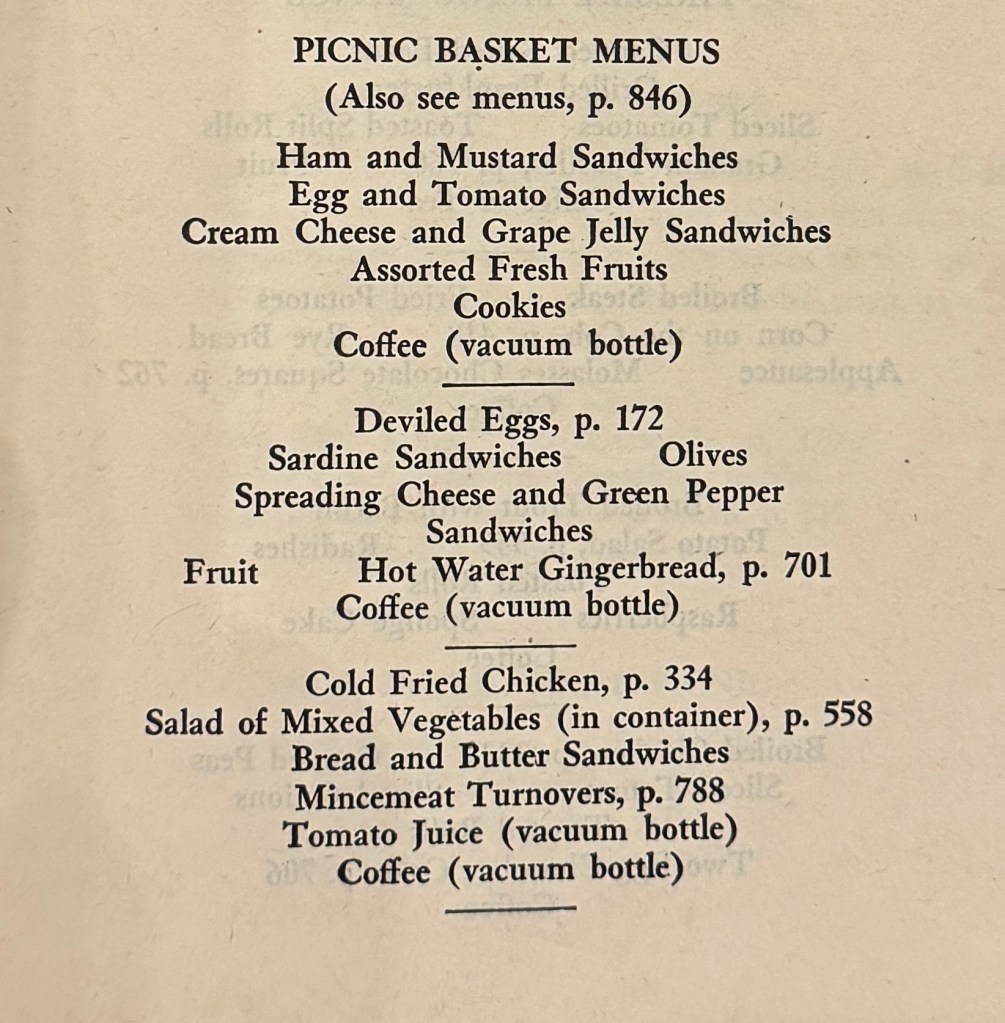
Now that we are well-versed in picnic etiquette, let’s look at some menus. In the 1944 edition of The Good Housekeeping Cook Book, there are several picnic menus. There’s also some picnic packing advice. Again, I’ve summarized:
Pack things in tightly lidded glass jars, take a hot dish in a vacuum jug, and include cake, fruit, cookies, milk, and coffee. The folks at Good Housekeeping seem to disagree with Emily Post and suggest that it is easier to take all sandwich supplies individually and let people make their own. Of course, Good Housekeeping also says that having a fire to cook over is best, and they go as far as saying “if men were given a choice, most of them would probably vote for the picnic where they can cook over the open fire”. There is a paragraph about backyard fireplaces that are used for “grill suppers” that allow for picnics in your own backyard, which were “very much in vogue”.
Here are some of those menus:

Picnics ended up being quite a lengthy topic to write about! Come back tomorrow for the recipes we made, a bit more picnic advice from Woman’s Day magazine, and some menus from Wartime Entertaining.
 History in the Kitchen